In the liturgy of the word Christians come together to thank God for God’s gifts. Listening toGod’s word (the Bible) they grow in faith more conformed to the mind of Christ. Liturgy celebrates the wonders of creation and gives thanks for the reality of redemption. The liturgy is a celebration not of what God has said, but of God today speaking to our hearts and souls.
A).The First Reading: -The Hebrew Scriptures: The first reading is mostly chosen from the Old Testament and during some seasons the Book of Acts might be read. This reading usually harmonizes with the Gospel reading (see below). This reveals the continuity between Israel and Jesus who comes not to replace but to fulfill Israel.
B).The Responsorial Psalm: The Psalm reflects themes in the readings. The Psalm consists of an antiphon. This is a vehicle of prayer and praise – an atmosphere of prayer within which the readings occur.
' Mass ' is one of the names by which the sacrament of the Eucharist is called in the Roman Catholic Church, Latin liturgical rites, Western Rite Orthodox Churches, as well as in similar celebrations in Old Catholic Churches, in some Anglican parishes, and in many Lutheran Churches. In the Liturgy of the Word, the Church feeds the people of God from the table of his Word (cf. Sacrosanctum Concilium, no. The Scriptures are the word of God, written under the inspiration of the Holy Spirit. In the Scriptures, God speaks to us, leading us along the path to salvation. The Responsorial Psalm is sung between the readings. The Liturgy of the WordThe Readings.Roman Catholic AnswerThe Mass is divided into two parts, the first part of the Mass is called the Liturgy of the Word, the second part is the Liturgy of the. The liturgy is divided into two main parts: The Liturgy of the Word (Gathering, Proclaiming and Hearing the Word, Prayers of the People) and the Liturgy of the Eucharist (together with the Dismissal), but the entire liturgy itself is also properly referred to as the Holy Eucharist.
C). The Second Reading – The Christian Scriptures: This reading is also referred to as the Epistle, is usually from one of the letters in the New Testament which may also include the Book of Acts or the Book of Revelations. While the letters address particular situations in the early Church, their message transcends the centuries to motivate contemporary Christians and deepen our appreciation of the mystery of Christ.
D). The Gospel – Alleluia: “Alleluia” is a Latin echo of the Hebrew acclamation “Praise God!” and is a key word in Christian worship. Here it heralds the Gospel. In a solemn celebration the church deacon goes to the altar where the Gospel is enthroned. He lifts the book and, accompanied by servants (altar-boys) with candles and on some occasions incense (symbols of Christ’s light), processes with the Gospels held high while choir and community acclaim the good news with “Alleluia,” alternating with verses appropriate to today’s Gospel. Christians acclaim the most wonderful deed of God among humankind, Jesus Christ, here made visible in the book containing His words and message to us all.
E). The Gospel Reading: The Gospel is the climax of the liturgy of the word. Catholic faithteaches that in proclaiming the Gospel, Christ is truly present to the community. For this reason the community stands to witness to Christ’s resurrection which allows him to be present to his people.
As the deacon or priest introduce the Gospels all in the community sign themselves with thesign of the cross traced on the forehead, the lips and over the heart. This signing reminds us “Christ in my thoughts” <forehead>, “Christ from my lips or what I say”<lips> and “Christ in my heart” <over the heart>
Hearing the Gospel proclaimed also reminds and identifies Catholics with the first communitywhich heard these words for the mouth of Jesus. On the conclusion of the reading the minister proclaims, “This is the Gospel of the Lord.” He means not the book, but the Gospel of Jesus Christ, the “Good News” itself. The community affirms in faith by responding, “Praise to you, Lord Jesus Christ”.
F).The Homily (ormini-sermon): Christians believe that “faith comes through preaching.”(Romans 3:13-15). This idea is rooted in Jewish belief that the creative power ofGod’s word transforms human life.
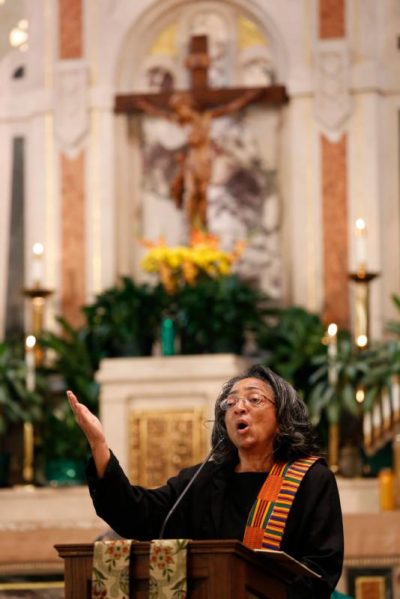
The Scriptures arenot always easy to understand and apply to present life. For this reason thehomily breaks open the Scriptures, showing how the word of God addresses us today. What import does the Gospel have for our lives today, for the world we live in, for issues in the community forum?
Difference Between Liturgy And Mass
G). The Profession of Faith: (the Creed): The Creed is a written profession summarizing thecommunity’s search for an ever deepening understanding of Jesus and His message. The Nicene-Constantinople Creed is most often used at Mass, although the Apostles’ Creed may be used at some liturgies. Please note that both creed’s are used by not only the Catholic Church, but also by Episcopalians, Presbyterians, Methodists, Lutherans, Orthodox and many other Christian faiths.
H).General Intercessions (Prayers of the Faithful): The people petition God for the needsof the Church, society, the parish, people in need, the sick and suffering, and those who have died. They direct our faith which has been deepened through prayer and listening to God’s word to specific situations today. These prayers conclude the Liturgy of the Word.
Liturgy Of The Word Vs Mass
Most of the Liturgy of the Word is made up of readings from Scripture. On Sundays and solemnities, there are three Scripture readings. During most of the year, the first reading is from the Old Testament and the second reading is from one of the New Testament letters. During Easter Time, the first reading is taken from the Acts of the Apostles which tells the story of the Church in its earliest days. The last reading is always taken from one of the four Gospels.
In the Liturgy of the Word, the Church feeds the people of God from the table of his Word (cf. Sacrosanctum Concilium, no. 51). The Scriptures are the word of God, written under the inspiration of the Holy Spirit. In the Scriptures, God speaks to us, leading us along the path to salvation.
The Responsorial Psalm is sung between the readings. The psalm helps us to meditate on the word of God.
The high point of the Liturgy of the Word is the reading of the Gospel. Because the Gospels tell of the life, ministry, and preaching of Christ, it receives several special signs of honor and reverence. The gathered assembly stands to hear the Gospel and it is introduced by an acclamation of praise. Apart from Lent, that acclamation is 'Alleluia,' derived from a Hebrew phrase meaning 'Praise the Lord!' A deacon (or, if no deacon is present, a priest) reads the Gospel.
After the Scripture readings, the celebrant preaches the homily. In the homily, the preacher focuses on the Scripture texts or some other texts from the liturgy, drawing from them lessons that may help us to live better lives, more faithful to Christ's call to grow in holiness.
In many Masses, the Profession of Faith then follows the homily, either the Nicene or Apostles' Creed. The Nicene Creed is a statement of faith dating from the fourth century, while the Apostles' Creed is the ancient baptismal creed of the Church in Rome. If baptismal promises are renewed, from a formula based on the Apostles' Creed, this takes the place of the Creed.
The Liturgy of the Word concludes with the Universal Prayer, also called the Prayer of the Faithful. The gathered assembly intercedes with God on behalf of the Church, the world, and themselves, entrusting their needs to the faithful and loving God.
Liturgy Of The Word Mass
Additional Information on the Liturgy of the Word
- Preaching Resources (coming soon)