- Set Read Receipt On Outlook 2016 For A Mac Free
- Outlook 2016 Read Receipt Settings
- How To Setup Read Receipt In Outlook
- Set Read Receipt On Outlook 2016 For A Mac File
If you always want to send a read receipt, here’s how to set it in the Messages app. In the Messages app, go to Preferences Accounts, and click on the account you use in the left pane. Outlook for Microsoft 365 for Mac Outlook 2016 for Mac Outlook 2019 for Mac More. Less Read receipts and delivery notifications are available in only some versions of Outlook for Mac, and only when using a Microsoft 365 work or school account, or an Exchange Server account managed.
Pre-Flight Check
- These instructions are intended specifically for setting up a new email account in Microsoft Outlook 2016 for Mac OS X 10.11.3.
- If you have not already created an email address on your server, visit our New User Tutorial: Creating E-Mail Addresses in cPanel.
- If you need to configure your email address in Outlook 2016 for Microsoft Windows, see How To Set Up Email in Outlook 2016. For other mail clients, check out our tutorial on setting up other email clients.
/StuckinOutbox-5bd9b2e446e0fb00514d5d12.jpg "2016")
Step #1: Add or Edit the Email Account
- To set up a new email account or edit the settings on an existing one, click the Tools menu and then select Accounts to open the Accounts panel.
- The setup process is slightly different depending on whether you have any existing email accounts configured in Outlook 2016:
- Setting up your first email account: If this is your first time setting up Outlook 2016, you will need to click on the envelope icon next to the third option: Other Email (iCloud, Google, Yahoo!, or other accounts):
- Setting up an additional email account: Once any email account has been set up in Outlook 2016, additional accounts can be added by clicking the plus sign in the lower left corner and selecting Other Email… from the pull-down menu:
- Changing the settings for an existing email account: Click on the account’s name in the account list on the left to make changes to any existing account in Outlook 2016, and skip ahead to Step #4: Editing an Existing Email Account.Note: You cannot edit an existing email account to directly change its connection method. To change an account from POP to IMAP or vice versa, simply add a new account for the email address as described below and select the desired connection type. Outlook 2016 will allow you to have multiple accounts for the same email address, so an account for sample@example.com using IMAP can coexist with an account for sample@example.com using POP. To prevent data loss, do not delete the existing account before adding a new one.
Step #2: Configuring a New Email Account
On the account information panel, enter the information as follows:- E-mail address: requires your complete email address, such as sample@example.com.
- Password: is the password associated with the email account.
- User Name: is your full email address. It should exactly match what you entered into the E-mail address field above.
- Type: you may select IMAP or POP. IMAP is recommended for its ability to sync messages between multiple devices (to learn more about the difference between the protocols, see IMAP vs POP3 email).
- Incoming server:
- When using standard (non-SSL) settings, use mail.yourdomainname.com
- When using secure (SSL) settings, use the server’s hostname (host.yourdomainname.com)
- The default port numbers should not need to be changed unless you have configured your server to use non-standard ports (not common)
- Check the box next to Use SSL to connect (recommended)
- Outgoing server:
- When using standard (non-SSL) settings, use mail.yourdomainname.com
- When using secure (SSL) settings, use the server’s hostname (host.yourdomainname.com)
- The default port numbers should not need to be changed unless you have configured your server to use non-standard ports (not common)
- Check the box next to Use SSL to connect (recommended)
Step #3: Configure Security Settings
When you add your email account, an alert window may prompt you to review security settings. This is expected if you have not already purchased and installed a signed, third-party verified SSL certificate on your mail server. If you see no such prompt, then you’re all set and can begin using Outlook 2016 with your email account immediately.If you do get a security prompt, which specifies that information that you view and send will be encrypted , note that Outlook 2016 will not be able to verify the security of the certificate through a third-party because you are the only authority validating it:If you wish to proceed with the connection, you have two options:
- You can click the Continue button to proceed, with the caveat that you may need to accept the warning each time Outlook connects.
- Or, you can permanently store the certificate and treat it as trusted, by clicking Show Certificate and then checking the box next to Always trust … before clicking Continue. You will need to authenticate with your password to store the exception for your self-signed certificate.
Step #4: Editing an Existing Email Account
 To change the settings on an existing email account, click the
  Tools menu and then select Accounts to open the Accounts panel.Click on the name of the account in the left pane, and make the desired changes:
- User Name: is your full email address. It should exactly match the value of the E-mail address field above.
- Password: is the password associated with the email account.
- Incoming server:
- When using standard (non-SSL) settings, use mail.yourdomainname.com
- When using secure (SSL) settings, use the server’s hostname (host.yourdomainname.com)
- The default port numbers should not need to be changed unless you have configured your server to use non-standard ports. If you do need to configure mail on a different port, you can check the box next to Override default port and enter the appropriate incoming mail server value (POP3 should be 110 for non-SSL connections and 995 when using SSL; IMAP should be 143 for non-SSL connections and 943 when using SSL.)
- Check the box next to Use SSL to connect (recommended) for a secure connection.
- Outgoing server:
- When using standard (non-SSL) settings, use mail.yourdomainname.com
- When using secure (SSL) settings, use the server’s hostname (host.yourdomainname.com)
- The default port numbers should not need to be changed unless you have configured your server to use non-standard ports. If you do need to configure mail on a different port, you can check the box next to Override default port and enter the appropriate outgoing mail server value (25 for non-SSL connections and 465 when using SSL; Unlike many other mail clients, Outlook 2016 does not require you to use port 587 on Mac OS X).
- Check the box next to Use SSL to connect (recommended) for a secure connection.
- The More Options… button will allow you to configure authentication for the outgoing (SMTP) mail server:
- Authentication: Typically, Use Incoming Server Info is sufficient, but if you receive connection errors due to SMTP authentication, you may need to select User Name and Password. Do not select None; you will not be able to send mail if None is selected as the authentication type.
- User Name: This field can only be filled in if you use the User Name and Password authentication type. If enabled, it must be the full email address.
- Password: This field can only be filled in if you use the User Name and Password authentication type. If enabled, use the email account’s password.
Bonus: Select IMAP Folders to Sync
Set Read Receipt On Outlook 2016 For A Mac Free
By default, Outlook 2016 for Mac OS X will sync all IMAP folders. To specify which ones you want to sync, pull down under the Tools menu and select IMAP Folders… to bring up the Folder Browser.In the Folder Browser, you will see a list of your accounts in the left pane.- In the first pane, click on the IMAP account’s name
- In the second pane, click on INBOX (or the desired custom folder, if listed)
- In the third pane, click on the folder to which you want to subscribe or unsubscribe.
- Folders to which you already are subscribed will be displayed in bold type, while folders to which you are not currently subscribed will be displayed in a light-face font. Note that on some versions of Mac OS X, the distinction can be almost imperceptible.
- Clicking on the name of a folder to which you are subscribed will allow you to click the red ( – ) Unsubscribe button in the top-left menu, and clicking on the name of a folder to which you are not subscribed will allow you to click on the green ( + ) Subscribe button in the top-left menu.
- You can not unsubscribe to default account folders, such as Drafts, Junk, Sent, and Trash.
Related Articles:
- 17 August 2014
- Updated: 28 July 2020
Outlook 2016 Read Receipt Settings
Microsoft Outlook allows you to assign two email tracking options within an email message. The options include a delivery receipt and/or a read receipt. It is useful to know the difference between these two options and any limitations in how they work. Once you know the specifics you can select the option which best suits your needs.
- Delivery Receipts provide a response when an email message has been delivered to the recipient’s email server. It is important to be aware that not all email servers are compatible with this function. A delivery receipt does not mean that the recipient has actually read your email message.
- Read Receipt provides a response when an email message has been opened and/or viewed. It is important to be aware that recipients can choose to not send a receipt in response to your request, so even if you do not receive a receipt, this does not mean your email has not been viewed.
Email, along with other areas of IT has moved along by leaps and bounds in the past few decades and as such so has email infrastructure. Although Delivery Receipts are available within Microsoft Outlook it is important to understand that many email servers are now configured NOT to send back delivery receipts. Generally, I will gauge whether an email has reached the recipient’s email server based on the lack of an undeliverable email message being received. If I don’t receive an undeliverable or bounce error, I can generally assume that the email has been delivered.
To track or not to track
It is possible to enable email tracking on all outgoing email messages; however, I have found that this can present two main disadvantages:
- One is the increase in time required to manage email messages. For users with low email usage, this is not a problem, however, if you are sending 50+ emails a day and you enable tracking on all emails, you are essentially adding an additional 50+ incoming email to your inbox in the form of a delivery or read receipt.
- The second disadvantage is that read receipts can be found by some users to be an annoyance. Depending on the setting your recipients have for dealing with a read-receipt request, it may give them cause to simply turn off the function and not participate in any future requests.
This feature is available across all the recent versions of Outlook including Outlook 365, Outlook 2019, Outlook 2016, Outlook 2013 and later.
Enable Email Tracking
If you wish to enable tracking on all your outgoing email, follow these steps:
- Open Microsoft Outlook (I’m using Outlook 2016)
- Select File > Options
- Click the Mail category from the left-hand sidebar
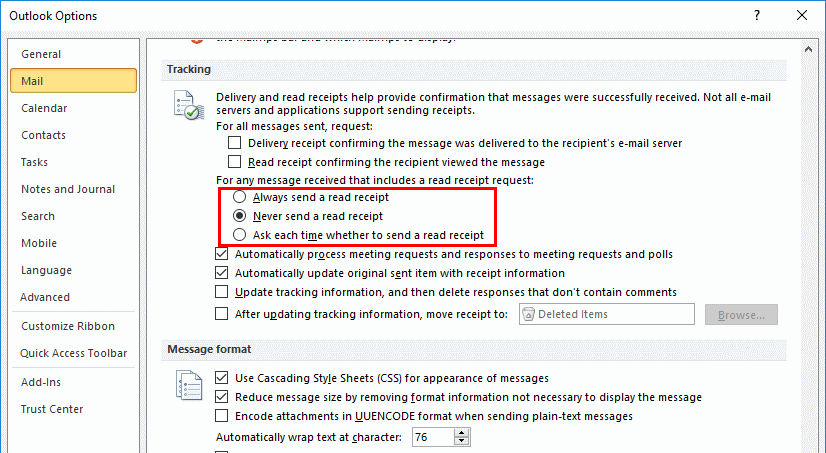
- Scroll down the window till you find the Tracking heading:
- Tick the option for Delivery receipt confirming the message was delivered to the recipient’s email server and/or Read receipt confirming the recipient viewed the message
- Click OK
- The tracking option will now be applied to all new email messages
Track individual email messages
How To Setup Read Receipt In Outlook
If you wish to enable email tracking on an individual email message, follow these steps:
- Create a new blank email message (Shortcut key Ctrl + N)
- Select the Options tab from the Ribbon
- Now select the checkbox within the Tracking group you wish to use: Request a Delivery Receipt and/or Request a Read Receipt
- Complete the rest of your email as normal and send the email
Read Receipt
A copy of the read receipt is received once the recipient opens the email message to view it. Remember to keep in mind that recipients can choose not to send a read receipt. If the email is not opened and simply deleted, you will receive a Not Read message.
Set Read Receipt On Outlook 2016 For A Mac File
- When the recipient receives your email and opens it, they will receive a notification as shown below when opening the email:
- If the recipient selects Yes, you will then receive a reply such as below:
That’s it for email tracking within Outlook. Be sure to check out other great posts relating to Microsft Outlook here.
- delivery, email, options, outlook, read, receipt, tracking