MySQL provides standards-based drivers for JDBC, ODBC, and .Net enabling developers to build database applications in their language of choice. In addition, a native C library allows developers to embed MySQL directly into their applications.
- Mysql Dsn Driver For Mac Catalina
- Dsn For Sql Server
- Mysql Dsn Driver For Mac Free
- Mysql Server Odbc Driver
- Mysql Dsn Driver For Mac Os
(mysql-connector-odbc-noinstall-8.0.21-winx64.zip) MD5: adb9cead5b571068037c49 Signature. We suggest that you use the MD5 checksums and GnuPG signatures to verify the integrity of the packages you download. Connector/ODBC is a standardized database driver for Windows, Linux, Mac OS X, and Unix platforms. MySQL ODBC 5.2 Unicode Driver version 5.2.7, (32-bit and 64-bit) For MySQL Community Server 5.6.12 on Mac OS X use: Actual Technologies, Open Source Databases version 4.0.0.
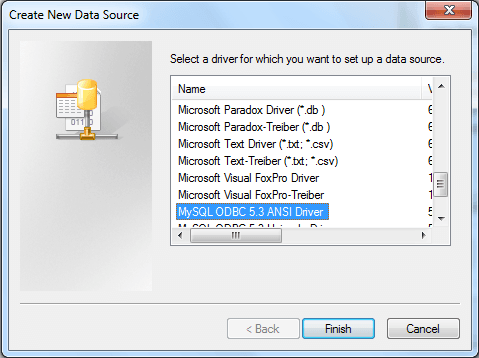
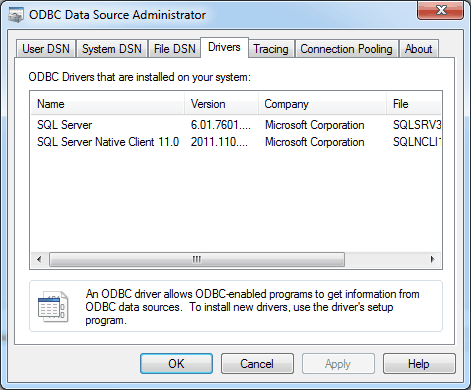
To create a DSN using the myodbc-installer utility, you only need to specify the DSN type and the DSN connection string. For example: // With Connector/ODBC 8.0: shell myodbc-installer -a -s -t'DSN=mydb;DRIVER=MySQL ODBC 8.0 Driver;SERVER=mysql;USER=username;PASSWORD=pass' // With Connector/ODBC 5.3: shell myodbc-installer -a -s -t'DSN=mydb;DRIVER=MySQL ODBC 5.3 Driver;SERVER=mysql;USER. The reason is that the 'register the driver' step still mentions version 5.1 and the 'create sample dsn' uses version 5.2. How to repeat: try installing the dmg like downloaded from the website and check your odbc administrator. No drivers will be shown. Open the content of the package in the dmg, rename the 'postflight.in.smake' to 'postflight. Select your data source driver and configure a DSN. Install the Actual ESS Adapter. Open ODBC Manager System DSN Add Select the 'Actual ESS Adpater' driver and select a DSN to adapt.
| Developed by MySQL | |
|---|---|
| ADO.NET Driver for MySQL (Connector/NET) | Download |
| ODBC Driver for MySQL (Connector/ODBC) | Download |
| JDBC Driver for MySQL (Connector/J) | Download |
| Node.js Driver for MySQL (Connector/Node.js) | Download |
| Python Driver for MySQL (Connector/Python) | Download |
| C++ Driver for MySQL (Connector/C++) | Download |
| C Driver for MySQL (Connector/C) | Download |
| C API for MySQL (mysqlclient) | Download |
These drivers are developed and maintained by the MySQL Community.
| Developed by Community | |
|---|---|
| PHP Drivers for MySQL (mysqli, ext/mysqli, PDO_MYSQL, PHP_MYSQLND) | Download |
| Perl Driver for MySQL (DBD::mysql) | Download |
| Ruby Driver for MySQL (ruby-mysql) | Download |
| C++ Wrapper for MySQL C API (MySQL++) | Download |
The ODBC drivers for Linux and macOS support AlwaysOn Availability Groups. For more information about AlwaysOn Availability Groups, see:
You can specify the availability group listener of a given availability group in the connection string. If an ODBC application on Linux or macOS is connected to a database in an availability group that fails over, the original connection is broken and the application must open a new connection to continue work after the failover.
The ODBC drivers on Linux and macOS iterate sequentially through all IP addresses associated with a DNS hostname if you are not connecting to an availability group listener, and multiple IP addresses are associated with the hostname.
If the DNS server's first returned IP address is not connectable, these iterations can be time consuming. When connecting to an availability group listener, the driver attempts to establish connections to all IP addresses in parallel. If a connection attempt succeeds, the driver discards any pending connection attempts.
Note
Because a connection can fail due to an availability group failover, implement connection retry logic; retry a failed connection until it reconnects. Increasing connection timeout and implementing connection retry logic increases the chance of connecting to an availability group.
Connecting With MultiSubnetFailover
Always specify MultiSubnetFailover=Yes when connecting to a SQL Server 2012 (11.x) availability group listener or SQL Server 2012 (11.x) Failover Cluster Instance. MultiSubnetFailover enables faster failover for all Availability Groups and failover cluster instance in SQL Server 2012 (11.x). MultiSubnetFailover also significantly reduces failover time for single and multi-subnet AlwaysOn topologies. During a multisubnet failover, the client attempts connections in parallel. During a subnet failover, the driver aggressively retries the TCP connection.
Mysql Dsn Driver For Mac Catalina
The MultiSubnetFailover connection property indicates that the application is being deployed in an availability group or Failover Cluster Instance. The driver tries to connect to the database on the primary SQL Server instance by trying to connect to all the IP addresses. When connecting with How to open cdx file. MultiSubnetFailover=Yes, the client retries TCP connection attempts faster than the operating system's default TCP retransmit intervals. MultiSubnetFailover=Yes enables faster reconnection after failover of either an AlwaysOn Availability Group or an AlwaysOn Failover Cluster Instance. MultiSubnetFailover=Yes applies to both single- and multi-subnet Availability Groups and Failover Cluster Instances.
Use MultiSubnetFailover=Yes when connecting to an availability group listener or Failover Cluster Instance. Otherwise, your application's performance can be negatively affected.
Note the following when connecting to a server in an availability group or Failover Cluster Instance:
Dsn For Sql Server
Specify MultiSubnetFailover=Yes to improve performance when connecting to a single subnet or multi-subnet Availability Group.
Specify the availability group listener of the availability group as the server in your connection string.
You cannot connect to a SQL Server instance configured with more than 64 IP addresses.
Both SQL Server Authentication or Kerberos Authentication can be used with MultiSubnetFailover=Yes without affecting the behavior of the application.
You can increase the value of loginTimeout to accommodate for failover time and reduce the application's connection retry attempts.
Distributed transactions are not supported.
If read-only routing is not in effect, connecting to a secondary replica location in an availability group fails in the following situations:
If the secondary replica location is not configured to accept connections.
If an application uses ApplicationIntent=ReadWrite and the secondary replica location is configured for read-only access.
A connection fails if a primary replica is configured to reject read-only workloads and the connection string contains ApplicationIntent=ReadOnly.
Specifying Application Intent
The keyword ApplicationIntent can be specified in your connection string. The assignable values are ReadWrite or ReadOnly. The default is ReadWrite.
When ApplicationIntent=ReadOnly, the client requests a read workload when connecting. The server enforces the intent at connection time, and during a USE database statement.
The ApplicationIntent keyword does not work with legacy read-only databases.
Targets of ReadOnly
When a connection chooses ReadOnly, the connection is assigned to any of the following special configurations that might exist for the database:
- A database can allow or disallow read workloads on the targeted Always On database. This choice is controlled by using the ALLOW_CONNECTIONS clause of the PRIMARY_ROLE and SECONDARY_ROLE Transact-SQL statements.
If none of those special targets are available, the regular database is read from.
The ApplicationIntent keyword enables read-only routing.
Read-Only Routing
Read-only routing is a feature that can ensure the availability of a read-only replica of a database. To enable read-only routing, all of the following apply:
You must connect to an Always On Availability Group availability group listener.
The ApplicationIntent connection string keyword must be set to ReadOnly.
The Availability Group must be configured by the database administrator to enable read-only routing.
Multiple connections each using read-only routing might not all connect to the same read-only replica. Changes in database synchronization or changes in the server's routing configuration can result in client connections to different read-only replicas. You can ensure that all read-only requests connect to the same read-only replica. Ensure this sameness by not passing an availability group listener to the Server connection string keyword. Instead, specify the name of the read-only instance.
Read-only routing may take longer than connecting to the primary. The longer wait is because read-only routing first connects to the primary, and then looks for the best available readable secondary. Due to these multiple steps, you should increase your login timeout to at least 30 seconds.
ODBC Syntax
Two ODBC connection string keywords support AlwaysOn Availability Groups:
ApplicationIntent
MultiSubnetFailover
Mysql Dsn Driver For Mac Free
For more information about ODBC connection string keywords, see Using Connection String Keywords with SQL Server Native Client.
The equivalent connection attributes are:
SQL_COPT_SS_APPLICATION_INTENT
SQL_COPT_SS_MULTISUBNET_FAILOVER
Mysql Server Odbc Driver
For more information about ODBC connection attributes, see SQLSetConnectAttr.
Mysql Dsn Driver For Mac Os
An ODBC application that uses AlwaysOn Availability Groups can use one of two functions to make the connection:
| Function | Description |
|---|---|
| SQLConnect Function | SQLConnect supports both ApplicationIntent and MultiSubnetFailover via a data source name (DSN) or connection attribute. |
| SQLDriverConnect Function | SQLDriverConnect supports ApplicationIntent and MultiSubnetFailover via DSN, connection string keyword, or connection attribute. |
